Jaali, cane, brass and kilim: Indian craft in a restrained home
The most interesting shift in Indian interiors is not European at all. How to bring the country's own craft into a quiet modern home, one or two pieces at a time, without it becoming a theme.
- Written by
- The Élara Studio
- Published
- Reading time
- 6 min read
For a decade the ambition of a well-off Indian home was to look like it was somewhere else: Scandinavia for a while, then Paris, then a beach house in a country with no monsoon. The homes people are asking us for now have stopped apologising for where they are.
Cane, jaali, hand-beaten brass, kilim, block-printed linen, terracotta, stone cut by hand. These are appearing in briefs that are otherwise very restrained, and they are appearing one or two pieces at a time, chosen for the hand in them rather than as a theme. It is the most interesting thing happening in Indian interiors, and it is easy to get wrong. This is how we get it right.
The rule: craft is the voice, not the field
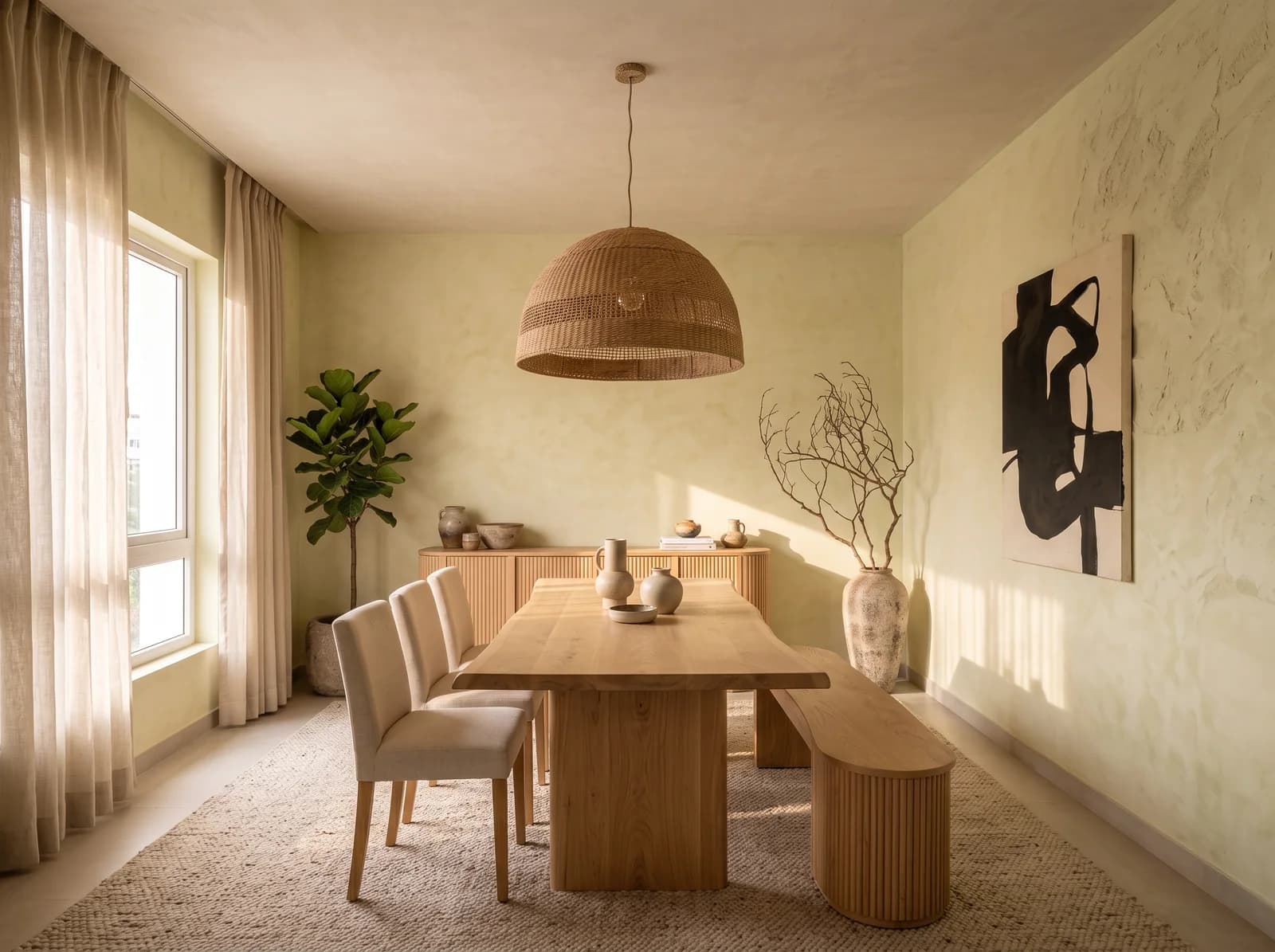
The ratio that governs every calm room applies here exactly. Seventy percent of the room is the quiet field: plaster, timber, stone, in tones that sit close together. Twenty percent is the support. Ten percent is the voice. Indian craft belongs in the ten percent, and occasionally the twenty. A room that is seventy percent jaali and block print is a hotel in Jaipur. A room of plaster and oak with one cane chair, one brass lamp and a kilim on the floor is a home in Bengaluru that knows where it is.
The seven crafts we reach for

Jaali
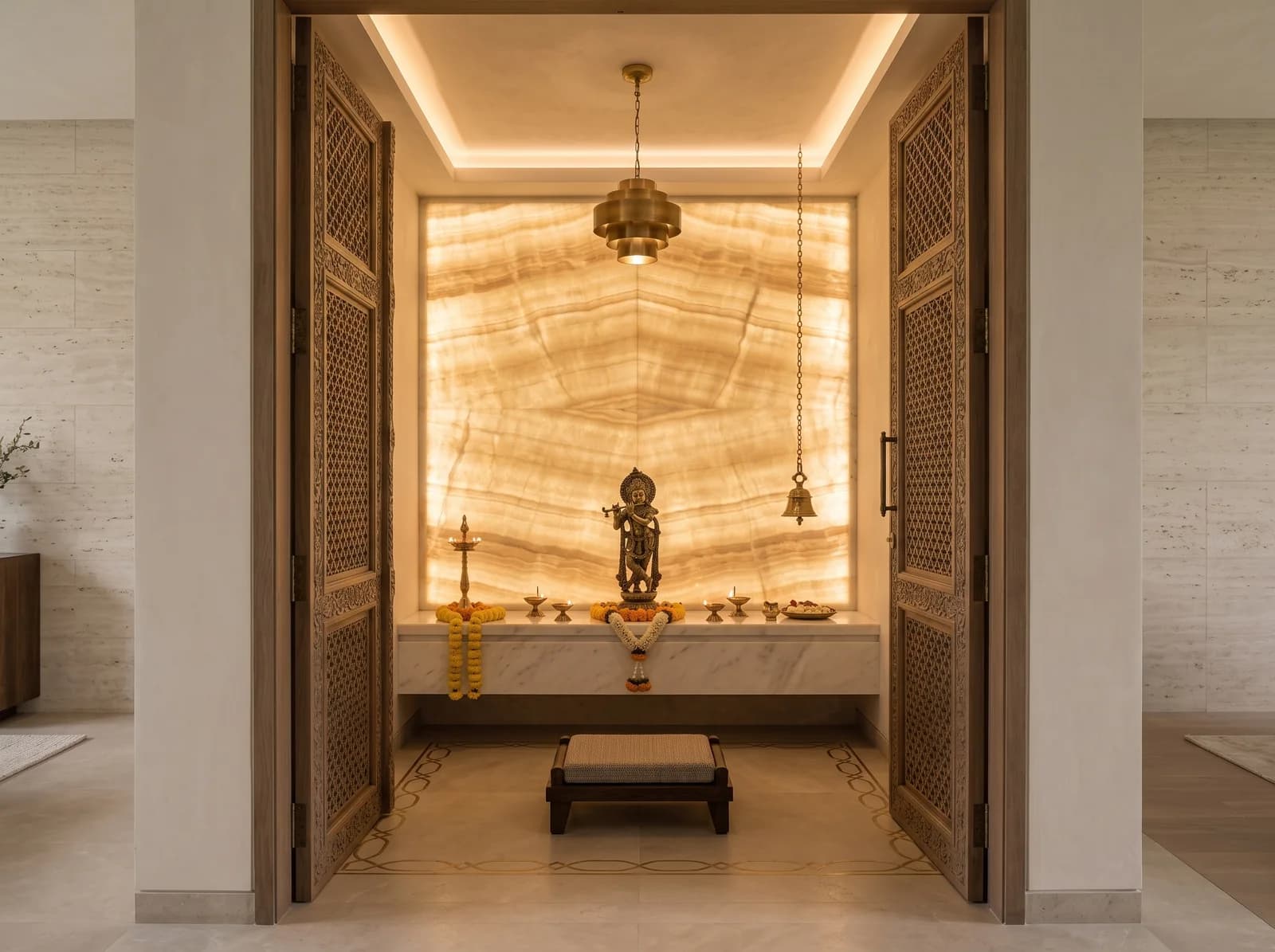
The pierced screen is the oldest piece of Indian architecture that still works in a flat. It filters harsh west light into pattern, gives privacy without a wall, and lets a pooja room's lamp show through a closed door. Where it goes wrong is when it is CNC-cut from MDF in a generic pattern and used as decoration on a television wall. Where it goes right is when it is carved in timber or cast in brass, in one place that needs its two jobs done, light and screening, and nowhere else.
Carved oak jaali doors on the Limestone Arch Villa's pooja room: the lamp shows through when they are closed. Studio visualisation.
Cane and rattan
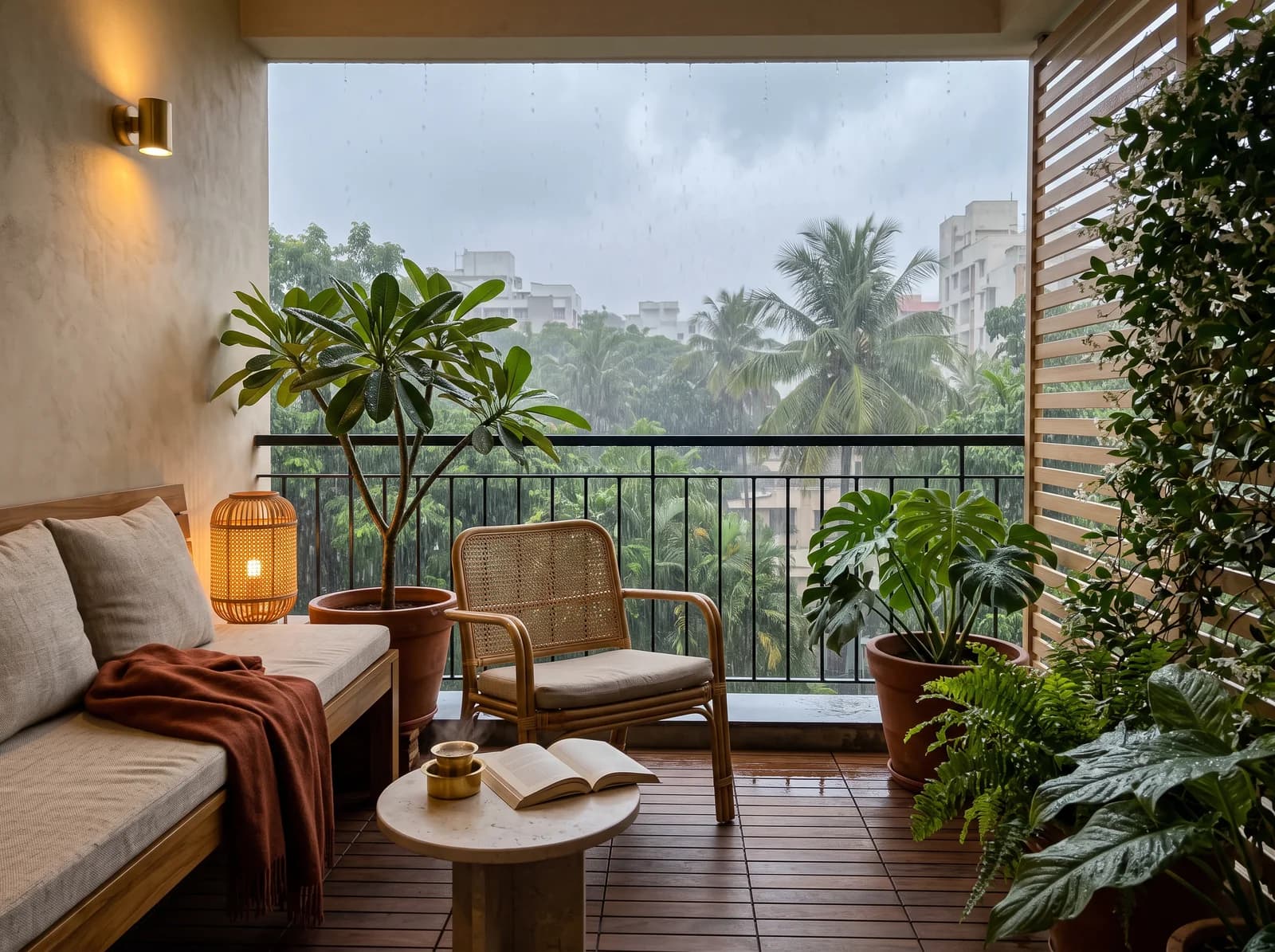
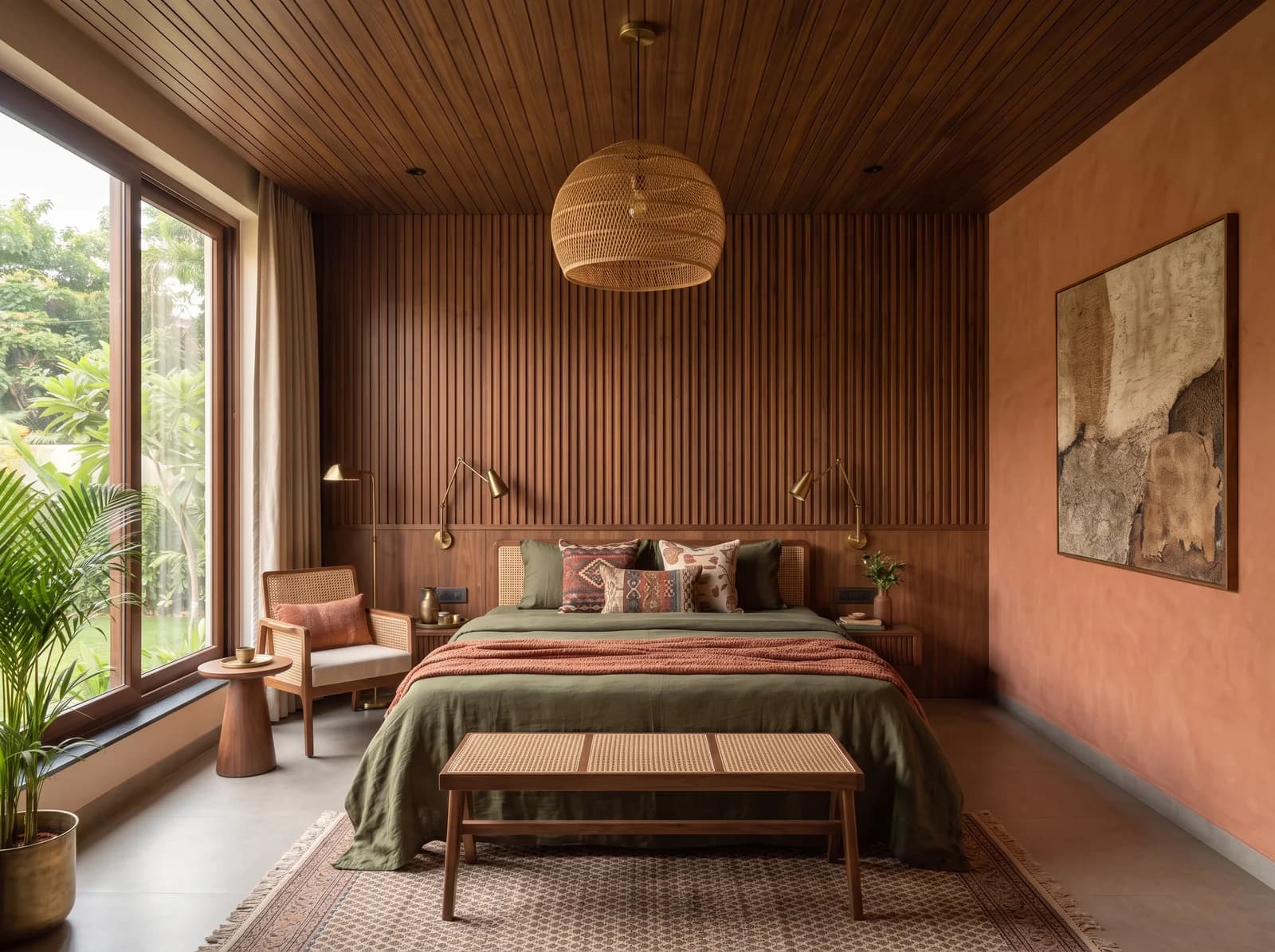
Cane is the craft with the easiest passage into a modern room, because a cane-backed chair, a rattan pendant or a woven cabinet door is light, textured and quiet. It cools a room visually in a way upholstery cannot, and it was in every good Indian house long before it was in every Scandinavian catalogue. One cane piece per room. A dining chair set, a bench at the foot of a bed, the doors of a sideboard, a single armchair on the balcony.
Brass
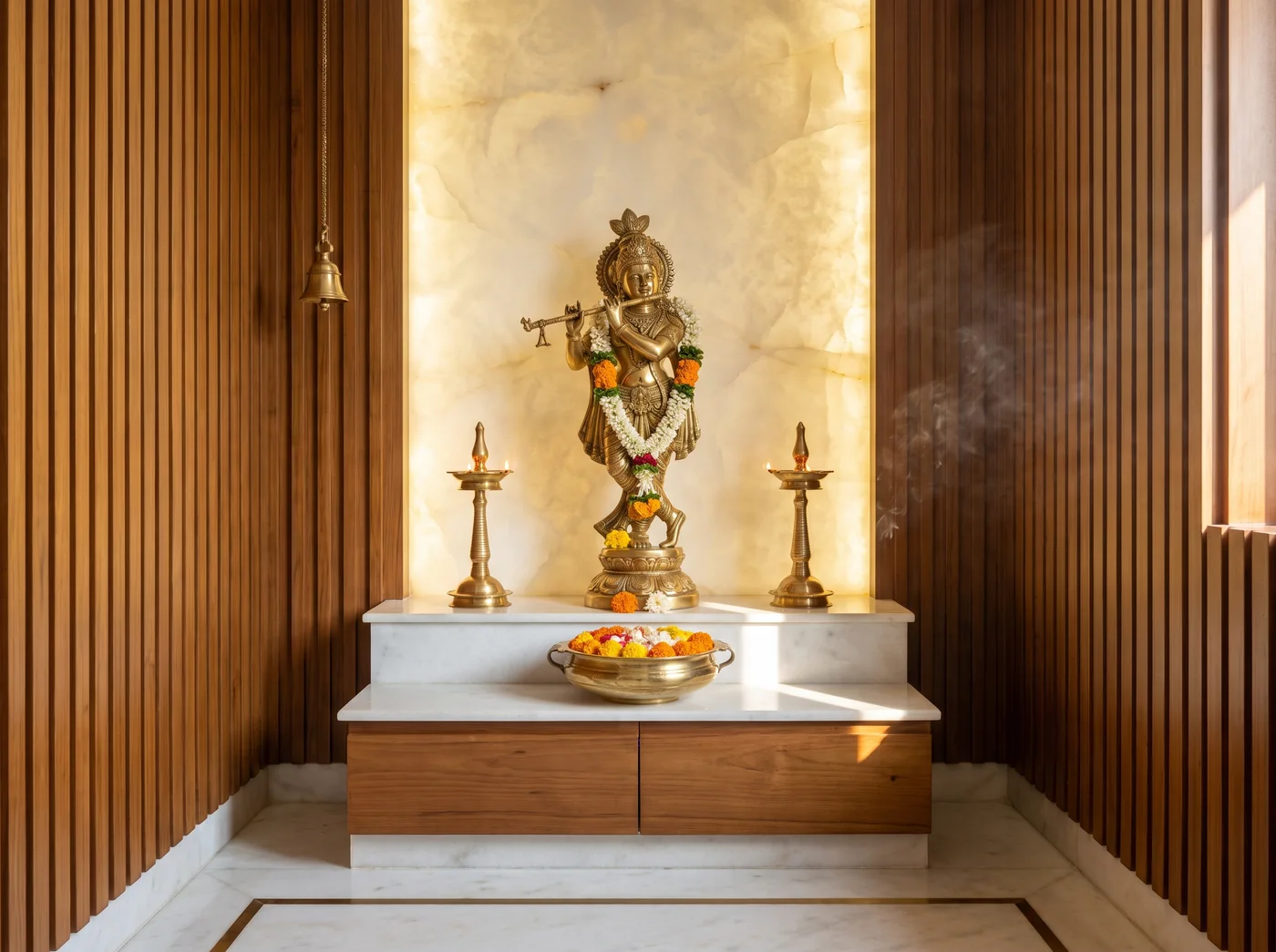
Hand-beaten, cast or turned, unlacquered so it darkens where hands land. Brass is the metal of every Indian ritual object and it is the metal that warms a room of oak and stone most completely. A pendant, a set of kitchen pulls, a lamp stem, the bell and the diya in the pooja room, an inlay in a tabletop. Kept out of the daily shower, where hard water pits it, and left alone everywhere else to keep time.
Kilim, dhurrie and the block print
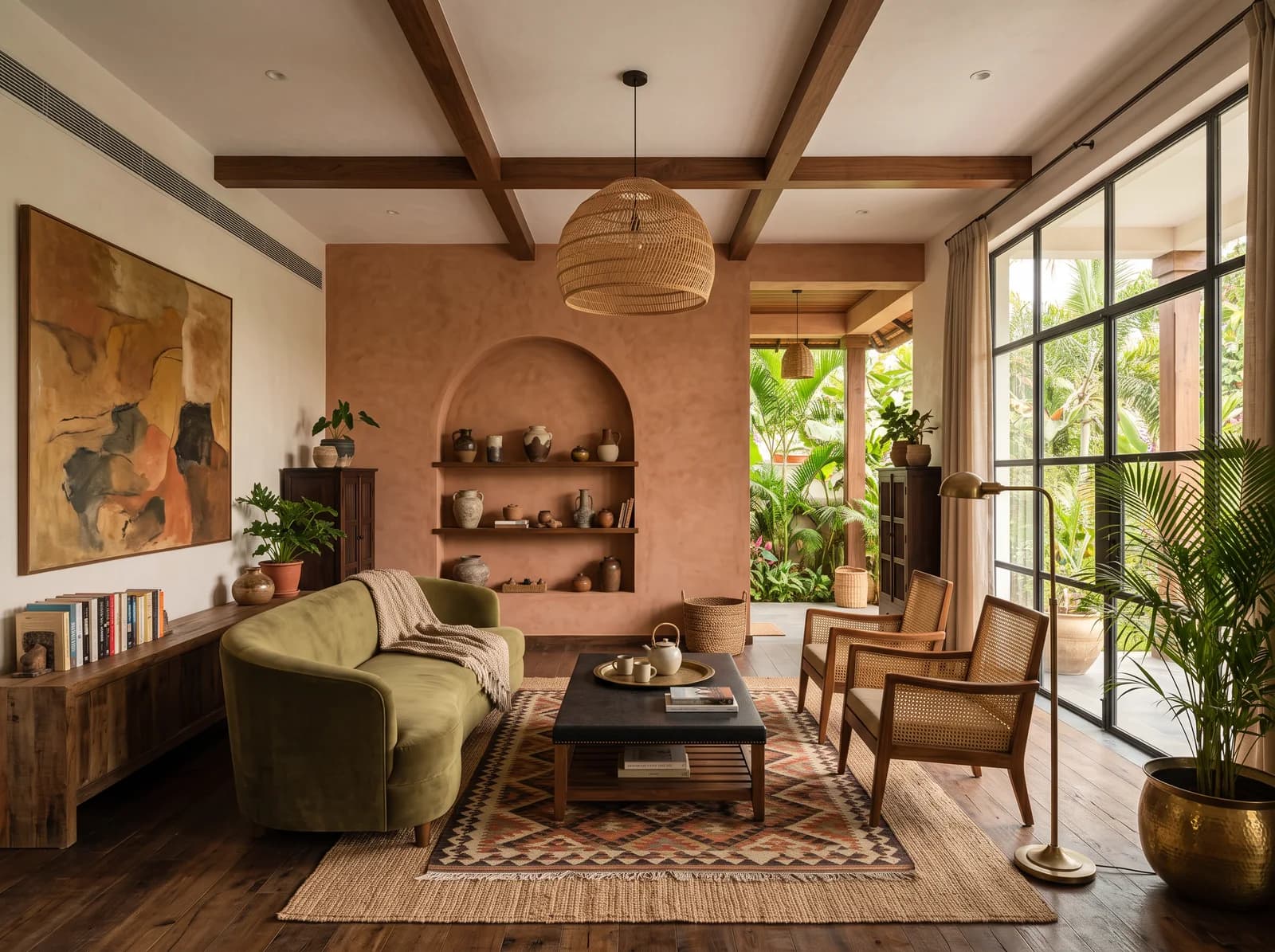
The soft layer is where Indian textiles do their best work, because they are made to be walked on and washed. A flat-woven kilim or a cotton dhurrie under the sofa, in a pattern that is old and colours that are from the ground. A block-printed linen on one cushion, the inside of a curtain, a bed throw. Ikat on one chair. The Olive Frame Villa's family room has a kilim, cane chairs, a rattan pendant and an arched niche of hand-thrown pottery, and everything else in it is plaster and walnut. That is the whole method in one room.
The family room of the Olive Frame Villa: kilim, cane, rattan and pottery as the voice; plaster and walnut as the field. Studio visualisation.
Terracotta and hand-thrown clay
A wall in terracotta plaster, a floor in handmade Athangudi or terracotta tile in one room, a row of unglazed pots on a ledge. Clay is the material India has built with for longest and it is having its moment for a reason: it is warm, matte, imperfect, and it goes with everything on this list.
Stone, cut by hand
Kota, Jaisalmer, Kadappa, a honed Indian marble rather than an imported one. Used as a floor, a plinth, a basin carved from a block, a threshold worn by feet. The country quarries some of the best stone in the world and ships most of it abroad; using it at home is both the sustainable choice and the more beautiful one.
The hand-made object
A Channapatna lacquered toy on a child's shelf. A bidri box on a desk. A brass uruli on a console with water and a flower in it. A hand-loomed throw. One object, chosen because someone made it, does more for a room than a wall of prints, and it is the object guests ask about.
Where it goes wrong
- The theme. Everything ethnic, all at once. Jaali on the wall, jaali on the cabinet, a carved swing, six kilims. It reads as a resort, and resorts are places you leave.
- The reproduction. A laser-cut MDF jaali, a printed kilim, brass-effect plastic. The point of craft is the hand; take it out and the object has no reason to be there.
- The wrong room. A carved swing in a 3BHK living room takes the space of a sofa and is sat in twice a year. A cane armchair on the balcony is sat in every evening.
- Colour without the field. Indian textiles carry strong colour, which is why they need a quiet room to sit in. Against a coloured wall they fight; against plaster they sing.
One room, done five ways, in five of the studio's languages
| Style | The field | The craft in the ten percent |
|---|---|---|
| Japandi | Pale oak, lime wash, linen | A jute chandelier, a cane bench, one ink-wash print |
| Earthy Modern | Walnut, terracotta plaster, olive | Kilim, cane armchairs, hand-thrown pottery in a niche |
| Quiet European | Limestone, fumed oak, plaster | Carved jaali doors, a brass pendant, an uruli |
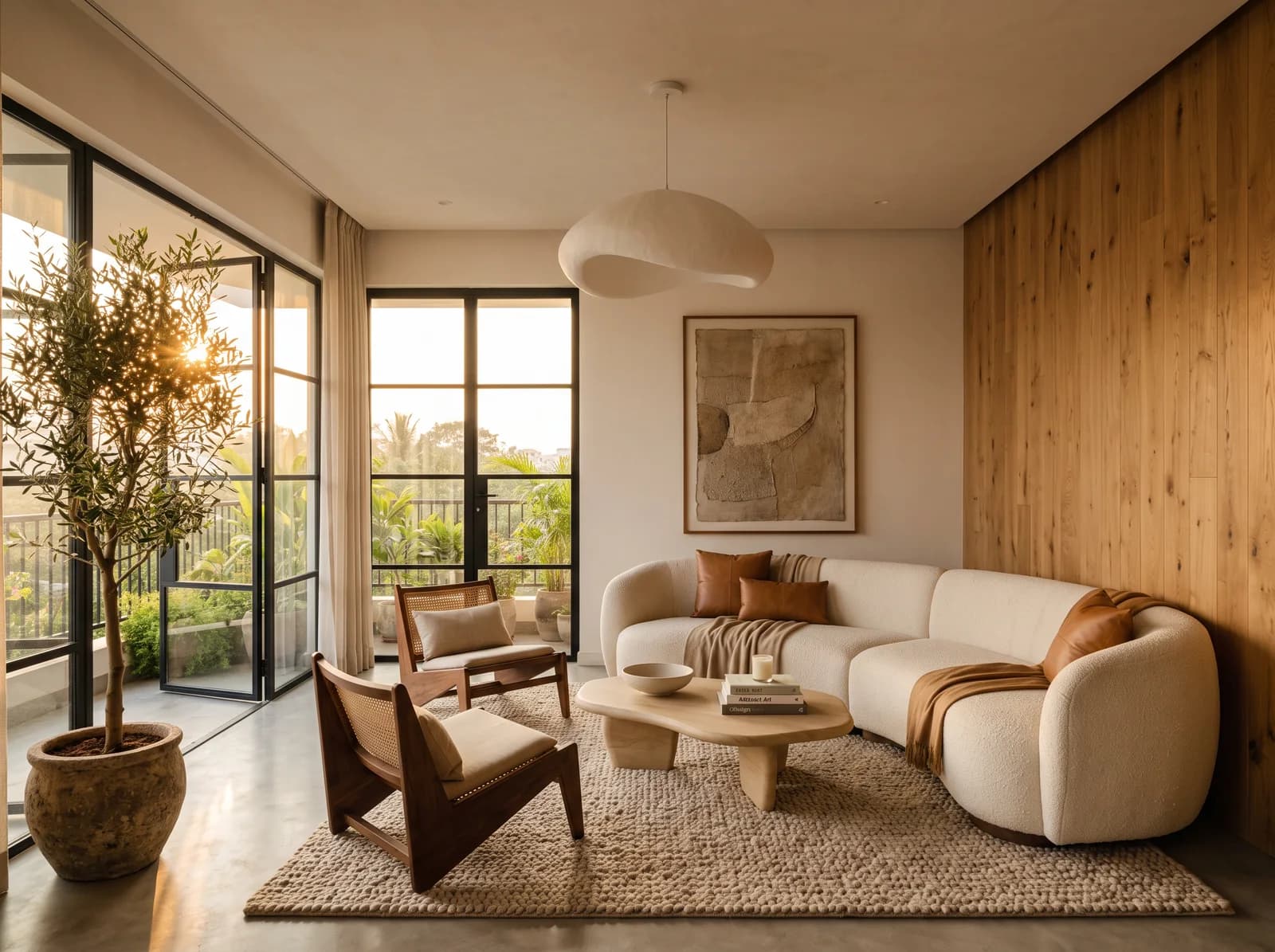
| Soft Minimalism | Chalk plaster, oak, bouclé | One block-printed throw, a rattan lantern |
| Contemporary Classic | Panelling, marble, brass | A bidri box, a brass jaali on the pooja door, a dhurrie |
The craft changes the accent, never the language. Each room is still recognisably its style, and recognisably in India.
If you have a grandmother's brass, a kilim you bought in Jaipur or a pair of cane chairs you cannot part with, tell us on the first call. They go into the brief, and the first free designs are drawn with them in the room, so the home is quiet, modern, and unmistakably yours.
Questions we get asked
- How do I use Indian traditional elements in a modern home?
- Keep the room's field quiet, in plaster, timber and stone, and let Indian craft be the voice: one or two pieces a room, chosen for the hand in them. A cane chair, a kilim, a brass lamp, a carved jaali door where light or privacy is needed. Avoid themes, reproductions and strong colour against coloured walls.
- Is a jaali still in style for modern interiors?
- Yes, when it does a job: filtering harsh light, screening without a wall, or letting a pooja room's lamp show through a closed door. Carved in timber or cast in brass, in one place. Laser-cut MDF jaali used as decoration on a television wall dates a room quickly.
- Which Indian textiles work in a minimalist interior?
- Flat-woven kilims and cotton dhurries underfoot, block-printed linen on a cushion or a throw, ikat on a single chair. They carry colour, so they need a quiet room of plaster and timber to sit in, where one piece can carry the whole room.
Photographs on the Journal are the studio's own visualisations of rooms as designed, captioned as such. Figures are indicative Bengaluru bands, dated in each post, never a quotation.