The 2026 interior trends worth keeping, and the ones to let pass
Every January brings a list, and most rooms outlive it. The trends actually arriving in our briefs this year, sorted by whether they will still look right in 2036.
- Written by
- The Élara Studio
- Published
- Reading time
- 9 min read
Trend lists are written for people who redecorate. Most of our clients are doing something else: fitting out a home once, properly, to live in for fifteen years. So this is a different kind of list, and beside every entry is the only question that matters to us. Will this still look right in 2036?
What follows is what we are actually seeing in briefs this year, in the photographs people send us and the words they use on the first call. Three verdicts. Keep means the trend is really a return to something sound, and we would build it into a home without hesitation. Borrow means it is good in one room or one gesture, and tiring across a whole house. Let pass means enjoy the photograph and leave it there.
Keep
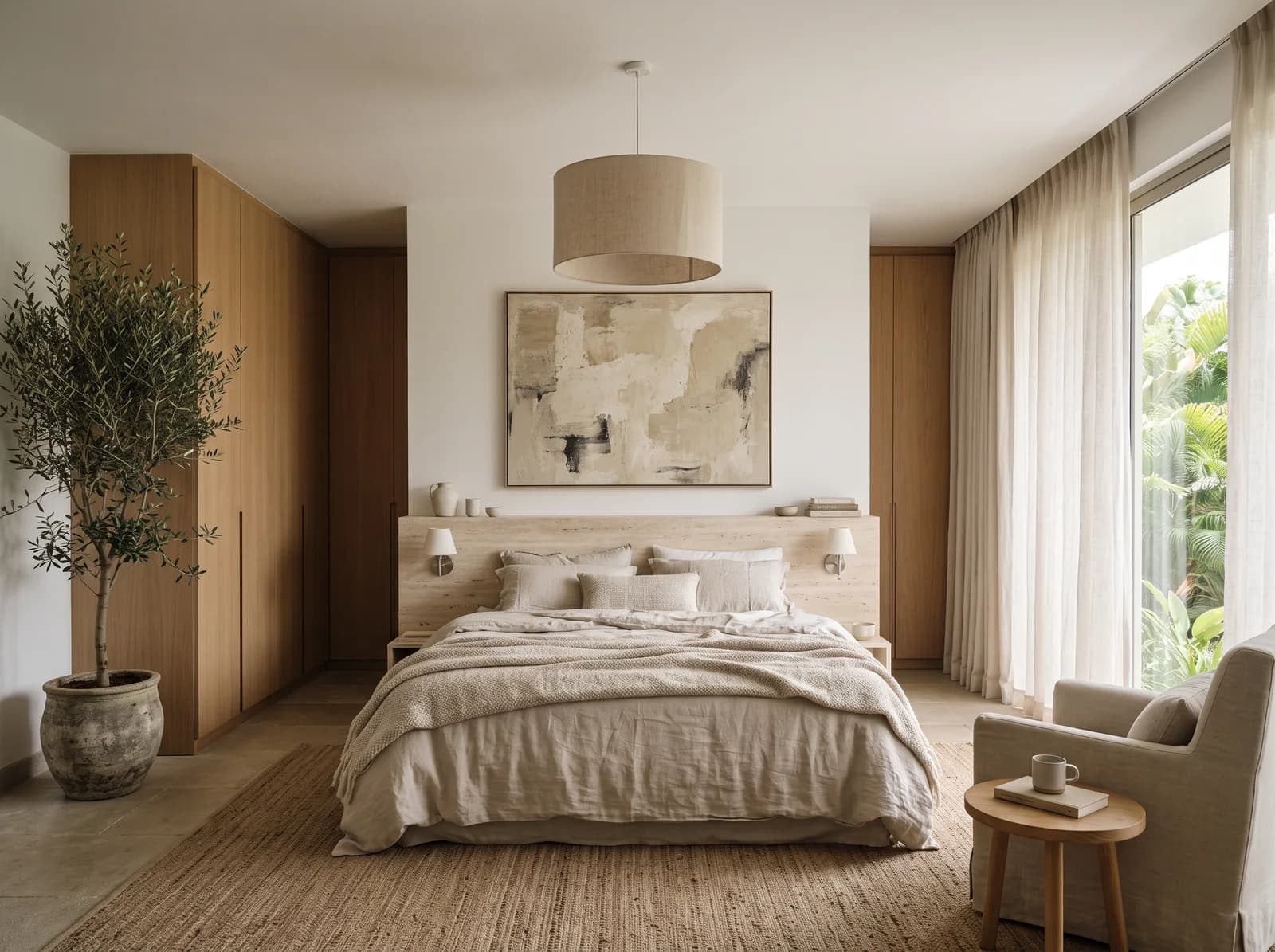

Warm minimalism, and the end of grey
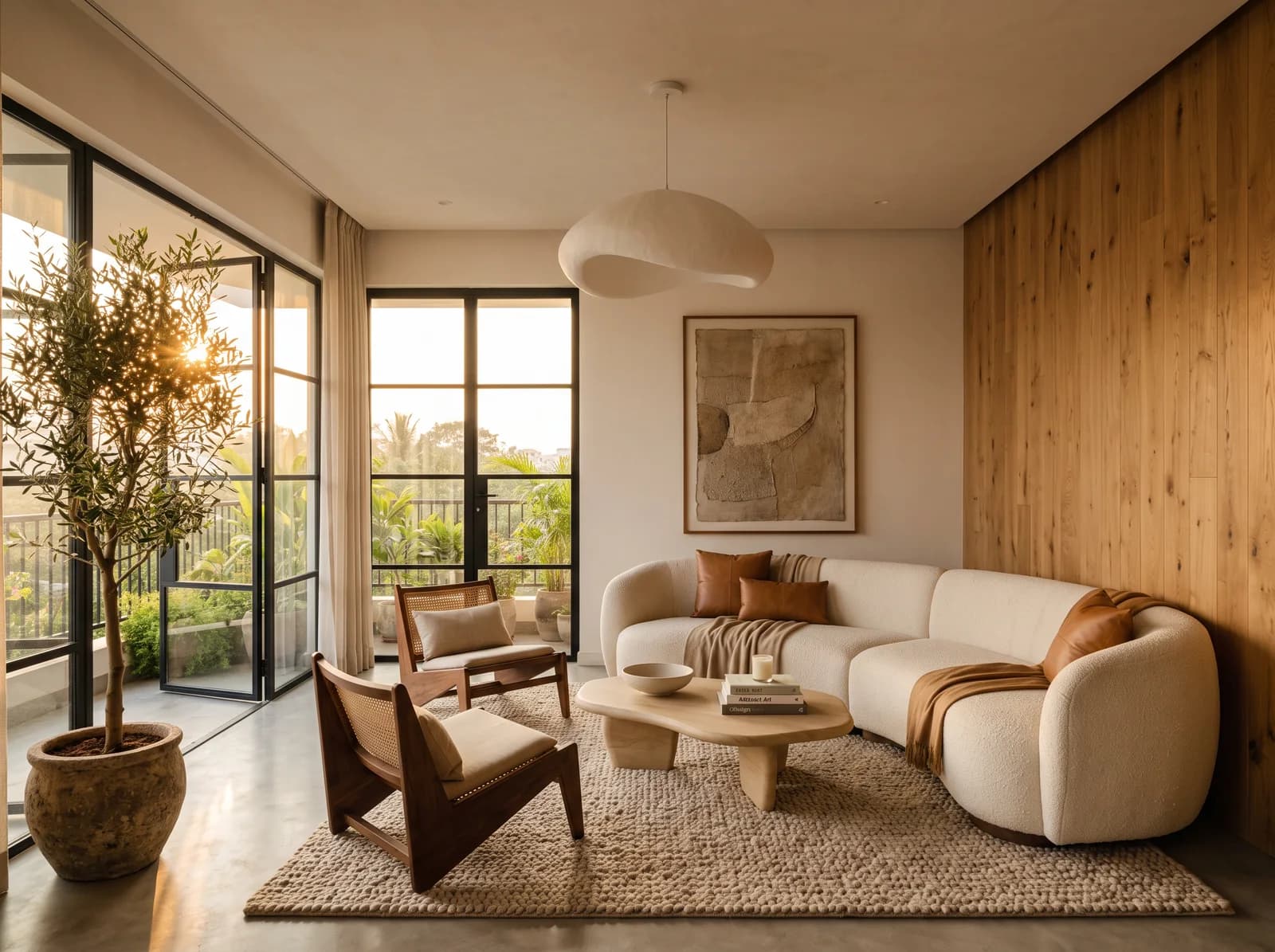
The grey decade is over, and nobody is mourning it. The rooms people send us now are chalk, string, oat, bone and parchment: whites with a little earth in them that hold the morning light instead of flattening it. This is not a fashion so much as a correction. Warm neutrals were the default in every good house before the greys arrived, and they will be the default long after. If your builder has handed you a grey-tiled shell, the fastest fix is a floor in a warm stone or a pale timber, and the rest follows. Our Soft Minimalism pages show a whole home built on this ground.
The Quiet Suite: chalk plaster, oak that reads as wall, travertine, one olive tree. Studio visualisation.
Plaster over paint
Lime plaster, clay plaster and their mineral cousins have moved from the one feature wall to the whole room, and they deserve it. A plastered wall changes across the day, breathes in the humid months and takes a mark with grace. Paint does none of these things. It costs more than a coat of emulsion and less than most wallpapers, and unlike wallpaper it will not peel at the seams in the third monsoon. We covered the material in the quiet luxury note; it remains the upgrade with the largest effect on how a home feels.
Honed stone, unbookmatched
The dramatic bookmatched slab, veined like a storm and polished like a mirror, has had its decade too. What is replacing it is quieter and better: limestone, travertine and sandstone with a honed or leathered face, laid in large formats so the floor reads as one surface. A honed stone absorbs light rather than throwing it back, forgives a dropped key and does not show every footprint. If you love a dramatic marble, give it one moment, a fireplace surround or a bar top, and keep the field quiet around it.
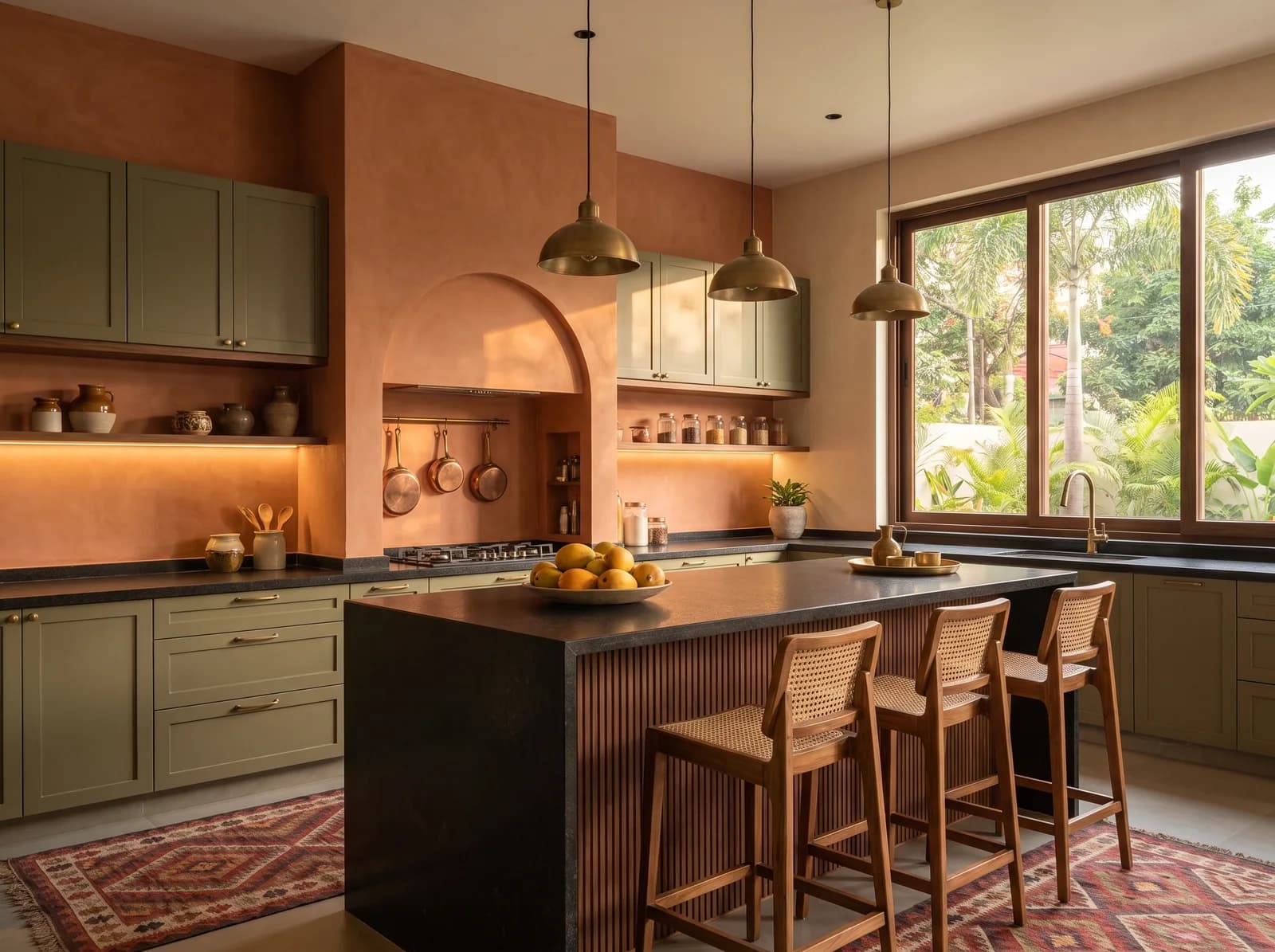
The kitchen becomes a room
The showroom kitchen, all handle-less gloss and a hood like a jet engine, is giving way to kitchens that look like furniture: framed cabinet doors, a plaster hood, a stone or timber island you would happily eat at, appliances behind pocket doors. It suits the Indian house particularly well, because the working part of the kitchen, the hob, the wet grinder, the pressure cooker, can sit in a second, closed kitchen while the room you see is the one you entertain in. The kitchen note explains how to plan the two.
The Olive Frame Villa kitchen: framed olive cabinetry, leathered granite, a plaster niche around the hob. Studio visualisation.
Light in layers, at 2700 Kelvin
The grid of downlights, the cove that glows blue and the ceiling in four levels of gypsum are the things clients now ask us to remove from their previous home. What replaces them is older and calmer: a few concealed sources for the general light, then lamps, wall lights and one good pendant that you actually switch on in the evening. Everything at a warm 2700 Kelvin, everything dimmable, and a scene or two that a child can operate. A room designed for its shadows looks expensive at night in a way no ceiling detail ever will.
Indian craft, in a quiet register
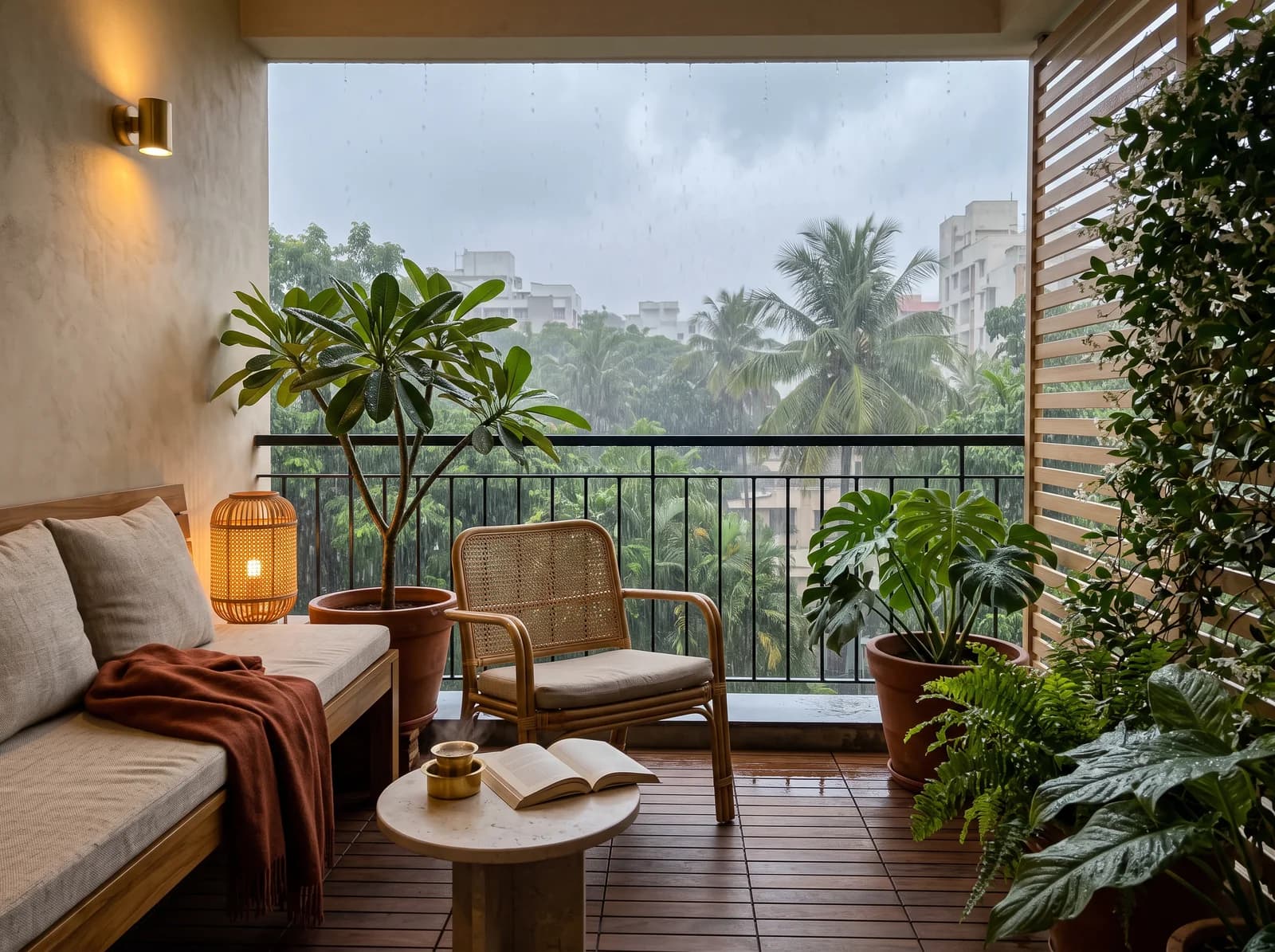
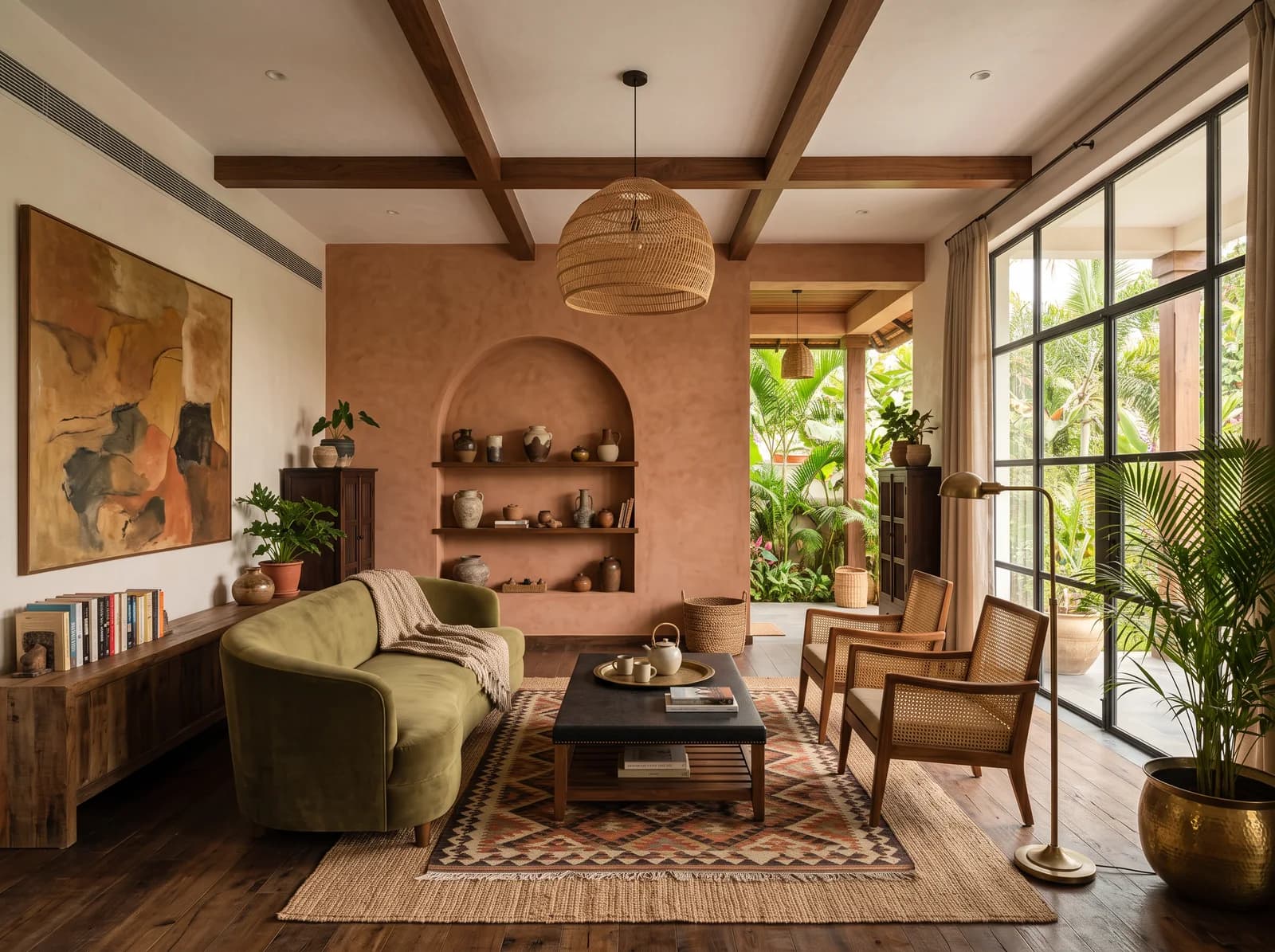
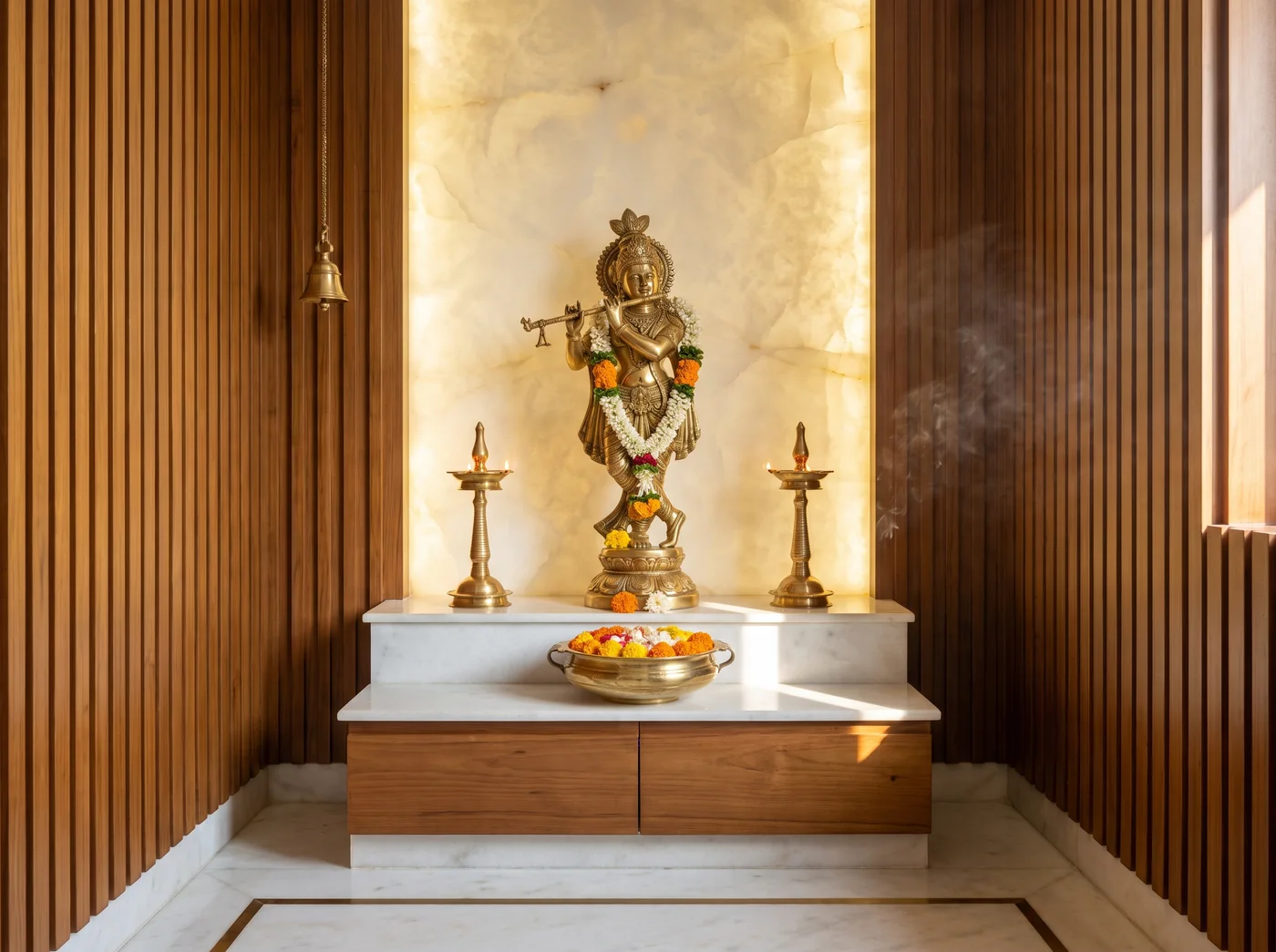
The most interesting shift of the year is not European at all. Cane, jaali screens, hand-beaten brass, kilim, terracotta and block-printed linen are appearing in rooms that are otherwise very restrained, one or two pieces at a time, chosen for the hand in them rather than as a theme. A pooja room is being designed as a proper room again, with stone, light and a door worth closing, instead of a niche in a passage. This is not a trend we expect to pass, because it is simply houses in India looking like they are in India. We wrote a whole note on it.
Buy once, repair, keep
The word in briefs is sustainability; the thing people actually want is a home that does not need redoing. The two turn out to be the same. Solid and veneered timber over foil-wrapped board, certified plywood, water-based lacquers, natural fibres, hardware rated for a hundred thousand cycles, and a studio that will still answer the phone in year six. It is why the ÉLARA Standard puts ten years on modular joinery in writing, and why every material on our floor is chosen for how it ages rather than how it photographs on day one.
Borrow
Colour drenching
One deep pigment on walls, ceiling, trim and joinery together, so the room becomes a single tone. In olive, umber, ink or a burnt terracotta it is glorious, and it is the trend we are asked about most this year. Our advice is to give it to one room that wants to be a cocoon: the media den, a study, a powder room, a bar. A living room drenched in olive is a wonderful photograph and a difficult place to spend a Sunday afternoon. The colour note shows these pigments used at a scale a family can live with.
Curves
The arch, the curved sofa, the rounded island end, the wall that bends around a sitting nook. Where the plan has room for one real arch, we will always take it; an opening with a curve on it changes how a whole floor reads. Curved joinery is another matter. A curved shutter or a radiused island costs more and takes longer than its straight equivalent, so curve where the eye lands, the sofa, one opening, a headboard, and keep the storage straight.
Fluted and slatted timber
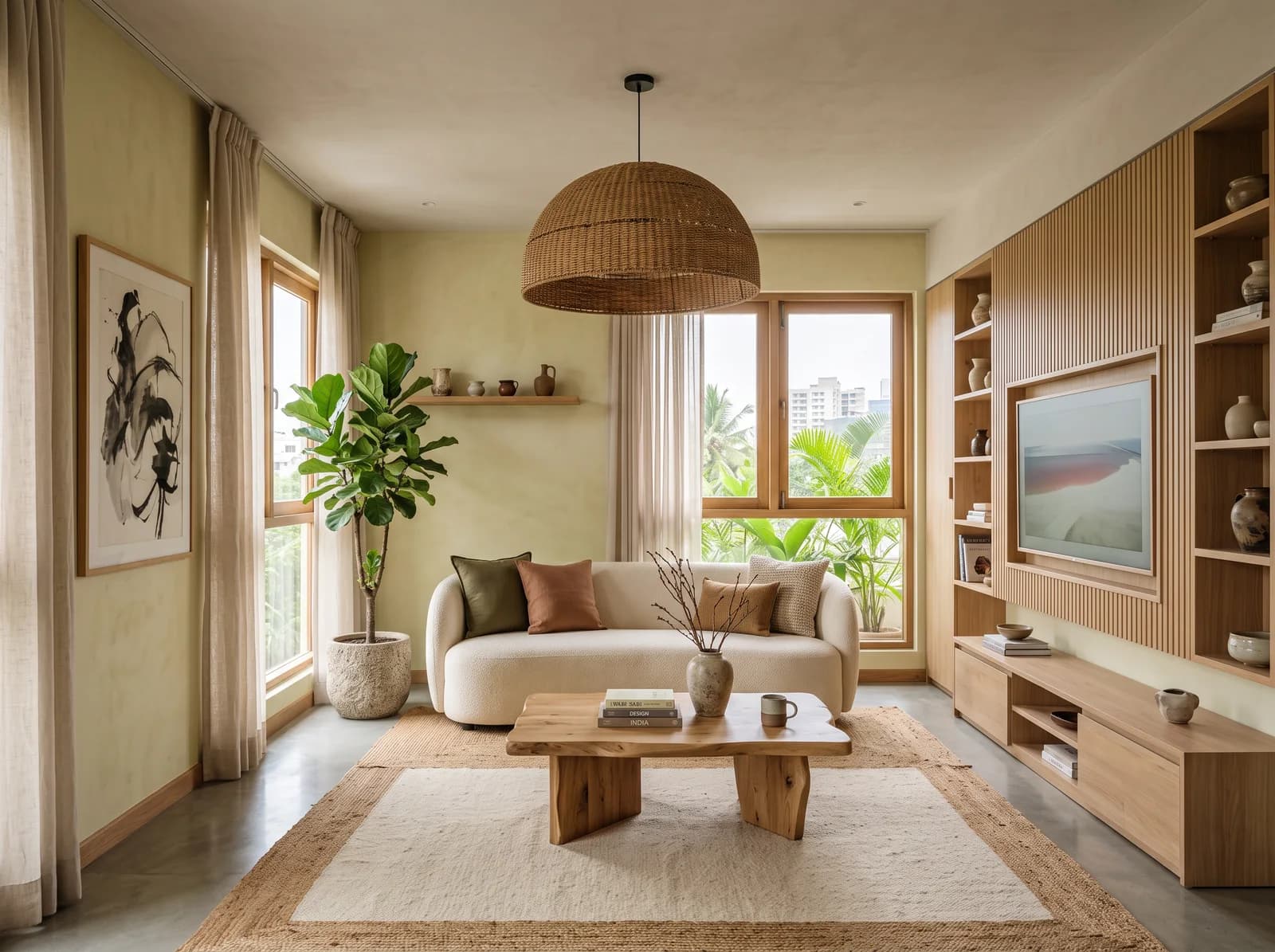
This is the trend at its peak, and the one most likely to date a room if it is used as wallpaper. Fluting earns its place where it does a job: softening the sound in a media room, giving a long media wall a rhythm, hiding the doors to a utility or a bathroom in a run of panelling. Used on every wardrobe, headboard, kitchen island and ceiling in the same house, it becomes noise. Our rule is one fluted surface per room, and in most rooms none.
The dark room
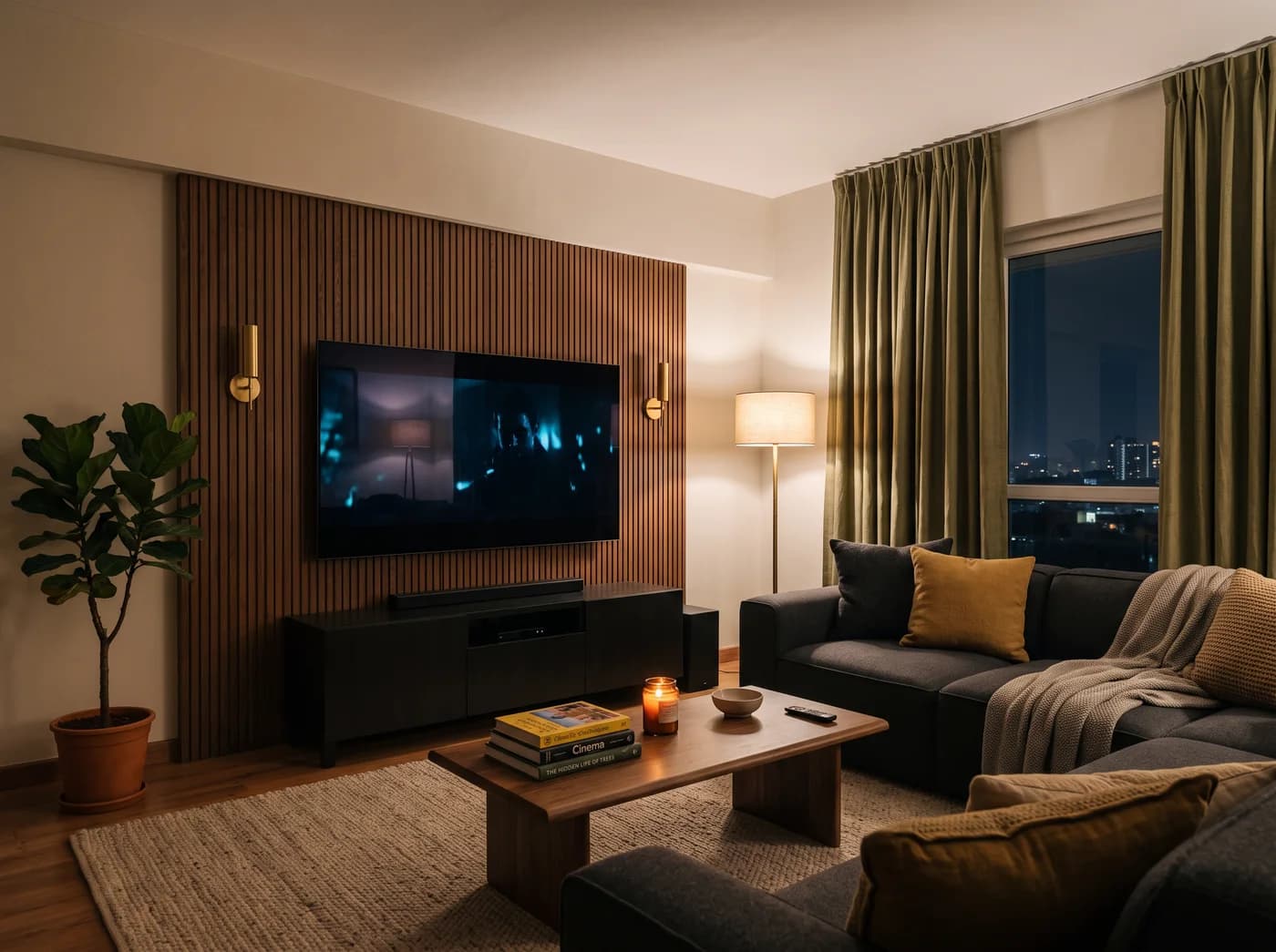
Media dens in charcoal and fumed oak, studies in walnut with a green lamp, bars in black granite and brass. We love them. Keep them to the rooms used after dark, so the daylit rooms stay light and the contrast between the two is the pleasure. The Walnut Hour Study and The Amber Bar Nook are the boutique's versions.
The quiet smart home
Automation has finally learnt to disappear. Nobody wants a tablet on the wall of a plastered living room. What works is lighting and curtains on a few well-named scenes, operated from the switch by the door and from a phone, with the equipment in a cupboard. Borrow the scenes, skip the gadgets, and insist on ordinary physical switches everywhere, because in year ten the app will have changed and the switch will not.
Let pass
- High gloss on anything large. Acrylic and lacquered gloss on a kitchen or a wardrobe shows every fingerprint and every scratch, and looks like the year it was fitted for the rest of its life.
- Grey on grey. The grey floor, the grey sofa, the grey wall. It is over, and the shell you have been handed is not a reason to continue it.
- The multi-level ceiling. Two or three tiers of gypsum with a coloured cove between them. One clean recess for the curtain track and the general light is all a ceiling needs. The ceiling note says why.
- Bouclé on everything. One curved piece in bouclé is a pleasure. A whole living room in it is a cloud you cannot clean.
- Open shelving in the working kitchen. Beautiful in the photograph, dusty in a fortnight and impossible with Indian cooking. Put the open shelf in the room you entertain in, with the five objects you actually like on it.
- Gallery walls of small frames. Twenty small pictures are a decision deferred. One large piece, hung low, is the decision made.
- The all-beige quiet luxury room. Beige paint, beige sofa, beige cushion. Quiet luxury is a material decision, and a room that has only the colour of it and none of the texture is a hotel lobby.
The verdicts, in a table
| Trend | Verdict | Where it belongs |
|---|---|---|
| Warm whites over grey | Keep | The whole home |
| Lime and clay plaster | Keep | Living rooms, bedrooms, the foyer |
| Honed stone, laid large | Keep | Floors, islands, bathrooms |
| The kitchen as furniture | Keep | The show kitchen; the wet kitchen stays practical |
| Layered warm light | Keep | Every room, at 2700K |
| Indian craft, quietly | Keep | One or two pieces a room; the pooja room |
| Colour drenching | Borrow | One cocoon room |
| Arches and curves | Borrow | One opening, the sofa, a headboard |
| Fluted timber | Borrow | One surface a room, doing a job |
| Dark rooms | Borrow | Den, study, bar |
| Hidden automation | Borrow | Scenes, with real switches |
| Gloss, grey, tiered ceilings | Let pass | The previous house |
Verdicts from the studio's own material board, September 2026. A trend that suits your home better than our rule is a conversation, not a mistake.
What none of this changes
Every one of the trends we would keep is really an old idea coming back: warm walls, honest stone, timber with a grain, lamps in the evening, a kitchen that looks like it belongs to the house. The ones we would let pass are the ones that only ever existed in photographs. That is the pattern in every year's list, and it is why our advice on trends is the same as our advice on everything else. Choose the materials for year ten, keep the ratio, light for shadow, and let the fashion arrive in the things that are easy to change: a cushion, a lamp, a rug, a coat of plaster in a new colour when you are ready.
If you are starting a home this year and want to see how these choices land in your own rooms rather than someone else's, the first design is free: photorealistic options for your floor plan within seven days, with a material board you can hold. The trends will still be there when you are done reading it. So will the stone.
Questions we get asked
- What are the biggest interior design trends for 2026?
- Warm whites replacing grey, lime and clay plaster in place of paint, honed stone laid in large formats, kitchens designed to look like furniture with the working kitchen concealed, layered warm lighting instead of downlight grids, colour-drenched single rooms, curves and arches, and Indian craft used sparingly in otherwise restrained rooms.
- Is grey out of style in 2026?
- Yes. The grey floor, grey sofa and grey wall of the last decade have given way to warm neutrals: chalk, string, oat and bone. If your builder delivered a grey shell, a warm stone or pale timber floor changes the whole home and the rest follows.
- Are fluted panels still in style in 2026?
- Fluted and slatted timber is at its peak, which is exactly when to use it carefully. It lasts where it does a job: softening sound in a media room, giving a long wall rhythm, or hiding doors in a run of panelling. Used on every surface in a house it dates the home quickly. One fluted surface per room is a good rule.
- Which 2026 trends suit Indian homes best?
- The kitchen designed as a room with a separate wet kitchen, lime plaster that breathes in humid months, honed stone floors that forgive daily use, the pooja room designed as a proper room, and Indian craft such as cane, jaali, brass and kilim used one or two pieces at a time.
- Do trends change what interiors cost?
- Materials move the number more than fashion does. Plaster, honed stone and curved joinery sit in the Premium and Signature bands; warm paint colours, layered lighting and better hardware cost little extra. The cost note on this Journal gives the current Bengaluru bands, and Élara's whole-home projects start from ₹11.99 lakh.
Photographs on the Journal are the studio's own visualisations of rooms as designed, captioned as such. Figures are indicative Bengaluru bands, dated in each post, never a quotation.