Is a PU finish durable? Yes, if it was sprayed like this
PU is the finish every showroom now sells and half of them cannot explain. What it is, how a good coat is built up in the factory, where it fails, what it costs against laminate, acrylic and veneer, and the questions to ask before you pay for it.
- Written by
- The Élara Studio
- Published
- Reading time
- 9 min read
A client sent us a photograph last month of a kitchen shutter with a chip the size of a rupee coin at the corner, four years old, and asked whether PU was a mistake. It was not. The chip told us three things about how that shutter was made, and none of them was the paint.
PU, short for polyurethane, has become the finish everyone asks for by name and few can define, which is how it gets sold badly. Done properly it is the most durable painted finish you can put on joinery, and the only one that gives you any colour you like with no seams. Done in a hurry it chips, yellows and shows every fingerprint. So here is what the good version actually is, where the corners get cut, and what the difference costs.
What PU actually is, and what it is not
A PU finish is a two-part polyurethane lacquer, a base and a hardener, sprayed over a sealed board in several thin coats and cured in a booth. The chemistry matters: it cross-links as it cures, so the film is hard, flexible enough not to crack, and resistant to water, oil and most of what a kitchen throws at it. It comes in matt, satin and high gloss, in any colour a paint shop can mix.
Three things are sold under the same name and are not the same thing. Duco is a nitrocellulose lacquer, older, cheaper and softer; it yellows in a couple of years and marks under a hot cup. PU-duco is a salesman's phrase that usually means duco with a PU top coat, or nothing in particular. And PU membrane or PU foil is a plastic film pressed onto a board with heat: a perfectly reasonable finish for a wardrobe interior, and not paint at all. When a quote says PU, ask which of the four it means.
- 2-part
- Base plus hardener; the film cross-links as it cures
- 6 sides
- A shutter is sprayed on every face and edge, or it is not sealed
- 7 days
- Full cure before a shutter should be handled or hung
How a durable coat is built, step by step
Durability is decided before the colour goes on. This is the sequence in a factory that does it well, and each step is one that a hurried workshop skips.
- 01The right board. HDHMR, never plywood and never MDF. Ply has a grain and a surface that moves; six months later the grain prints through the paint as fine lines, and the edges drink moisture and swell. The chip in that client's photograph was ply.
- 02Moisture and flatness. Boards are checked for moisture content and left to settle in the factory's air before cutting, so they do not move after they are painted.
- 03Machining, then sanding. Edges are profiled, grooves routed, and the whole shutter sanded to 180 then 240 grit, edges softened so the paint can wrap a rounded corner rather than break on a sharp one.
- 04Sealer, twice. Two coats of PU sealer or primer, sanded between coats to 320 grit. This is where the edges get their protection; a shutter sealed only on its face is a shutter waiting to swell.
- 05Colour, in thin coats. Two or three coats of pigmented PU, each thin, each flashed off before the next. Thick coats look fine on day one and craze later.
- 06Fine sanding and the top coat. A 400 to 600 grit sanding, then the clear top coat that sets the sheen: matt, satin or gloss. A matt top coat over a colour is what gives PU that soft, deep look no laminate has.
- 07Curing, in a booth, for days. Dust-free, at a controlled temperature, for forty-eight to seventy-two hours before handling and a week before installation. A shutter hung the day after it is sprayed will mark for a month.
- 08Checking. Film thickness with a gauge, sheen matched against the approved sample under the same light, a cross-hatch adhesion test on a sample panel from the same batch, and a hot-cup and turmeric test on that panel before the batch leaves.

Why it has to happen in a factory
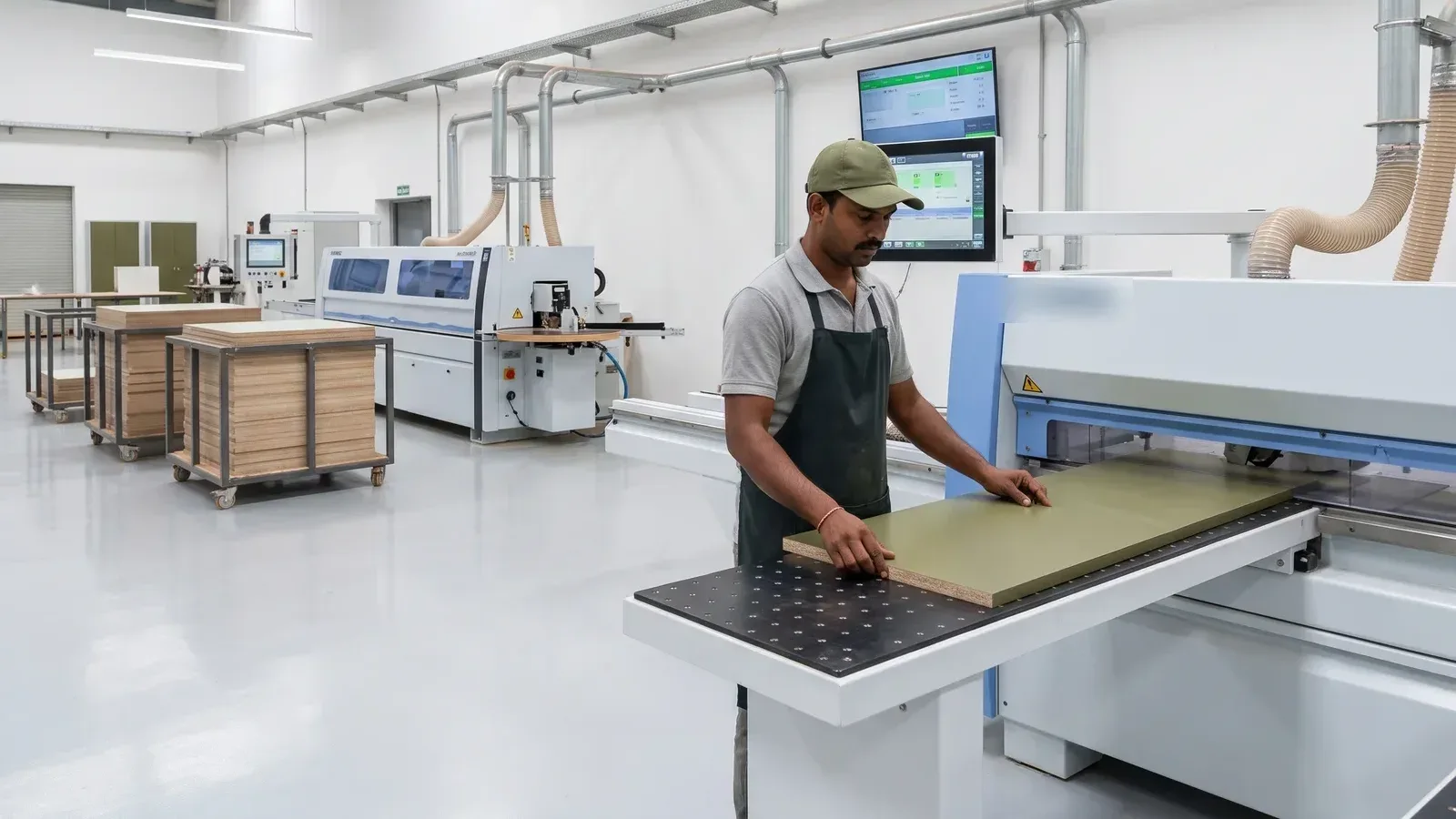
Every one of the eight steps needs something a site does not have: a booth without dust, a controlled temperature, a spray gun rather than a brush, a week of undisturbed curing, and a gauge to check the film. PU sprayed on site, in a flat with the windows open and the tiles being cut next door, is the PU that fails. Élara's shutters are finished in our own factory and arrive on site cured, wrapped and ready to hang, which is also why the site stays clean.
The board on the beam saw is the same olive that will be sprayed three rooms away, in a booth, a week before it is hung.
Where PU fails, honestly
- Edges and corners chip if the board is ply, the corner was left sharp or the sealer was skipped. On HDHMR with a softened edge and two sealer coats, a chip takes a real knock.
- Pure white yellows. All polyurethanes yellow slightly under sunlight and heat over years; on a bright white it shows. Specify a non-yellowing aliphatic PU for whites, or choose an off-white, chalk or warm white, which is kinder to the eye anyway and hides the drift entirely.
- High gloss shows everything. Fingerprints, dust, the swirl from a cloth. Gloss PU is beautiful in a photograph and hard work in a kitchen with children. Matt and satin are the honest choices for daily use.
- A hot pan set straight on it will mark it. So will it mark laminate and acrylic; nothing on this list is a trivet.
- Cheap PU is thin PU. Fewer coats, no top coat, no cure time. It looks identical on installation day and shows the difference in year two, which is why the process matters more than the brand of paint.
PU against laminate, acrylic and veneer
The honest comparison is not about which is best but about what each is for. A laminate is a printed sheet under resin, glued to a board with an edge band; it is the toughest, the cheapest, and it can never hide its joints or take a profile. Acrylic is a gloss sheet, deep and mirror-like, that scratches and shows its edge banding. Veneer is real wood, needs a polish or a lacquer over it, and moves near steam. PU is paint done properly: seamless, any colour, any profile, repairable in matt, and the most expensive of the four.
| Finish | Kitchen cabinetry, installed | Best at | Watch for |
|---|---|---|---|
| Laminate on ply or HDHMR | ₹1,700 – 2,100 / sqft | Budget kitchens, utility, wardrobe interiors, hard wear | Visible edge bands and joints; no profiles; cannot be repaired |
| Acrylic sheet | ₹2,000 – 2,500 / sqft | A flat high-gloss look at a mid price | Scratches; fingerprints; edge banding shows; dated quickly |
| Natural veneer, polished | ₹2,400 – 3,200 / sqft | Tall units, islands, anything you touch and do not cook near | Steam and heat; needs re-polishing; every sheet differs |
| PU, matt or satin | ₹2,600 – 3,200 / sqft | Framed and profiled shutters, colour, seamless runs, repairability | Process, not paint: board, sealer, coats, cure |
| PU, high gloss | ₹2,800 – 3,400 / sqft | A jewel-box bar or a dressing room | Fingerprints and dust; panel respray to repair |
Indicative Bengaluru bands for carcass, shutter, finish and hardware installed, per square foot of cabinetry face. They agree with the boutique's kitchen and wardrobe lines. The gap between laminate and PU on a large kitchen is real money; on a single wardrobe it is a few thousand rupees a door.
Where we use it, and where we do not
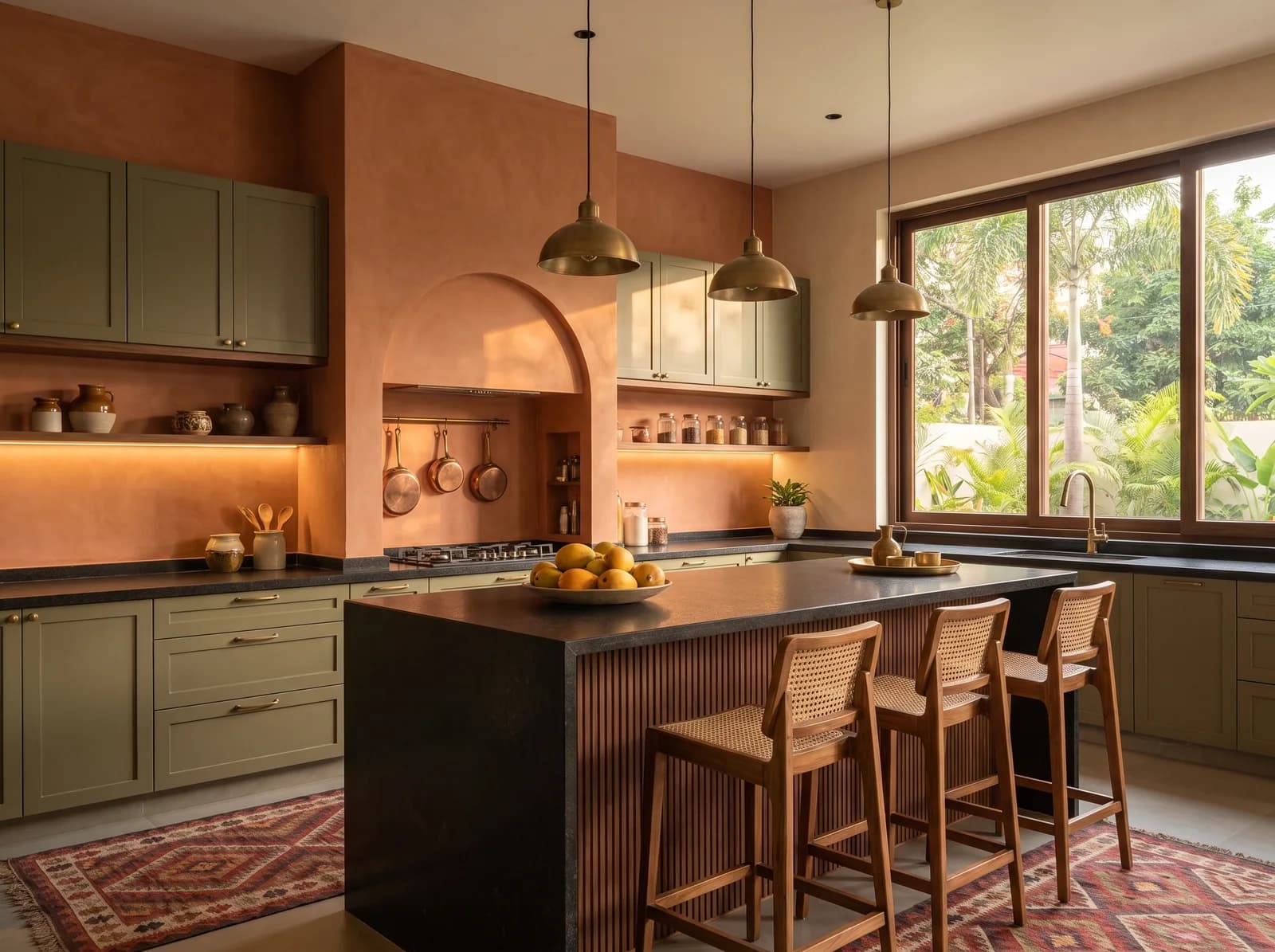
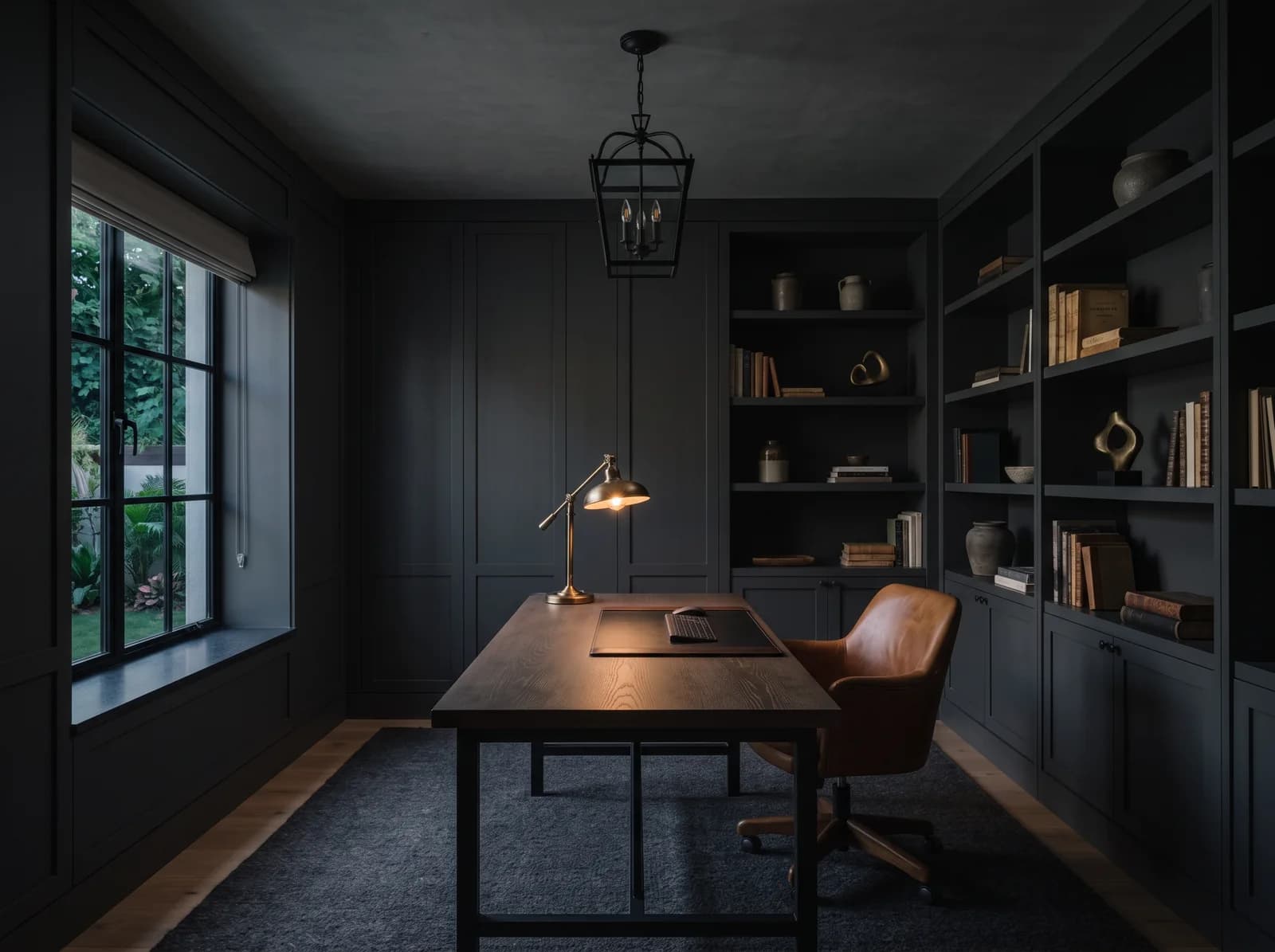
PU earns its price where you look at the door every day and where the design wants a colour, a frame or a groove: the kitchen shutters, the framed wardrobe doors in a primary bedroom, a study panelled floor to ceiling, a bar. It is wasted inside a wardrobe, in the utility and in a rented flat, where laminate does the job for less and nobody sees the edge band. Near the hob we prefer PU or a good laminate to veneer, because both take steam without complaint. And on a pooja room door or a media wall where the design wants real grain, veneer, not paint.
The checks a finish has to pass
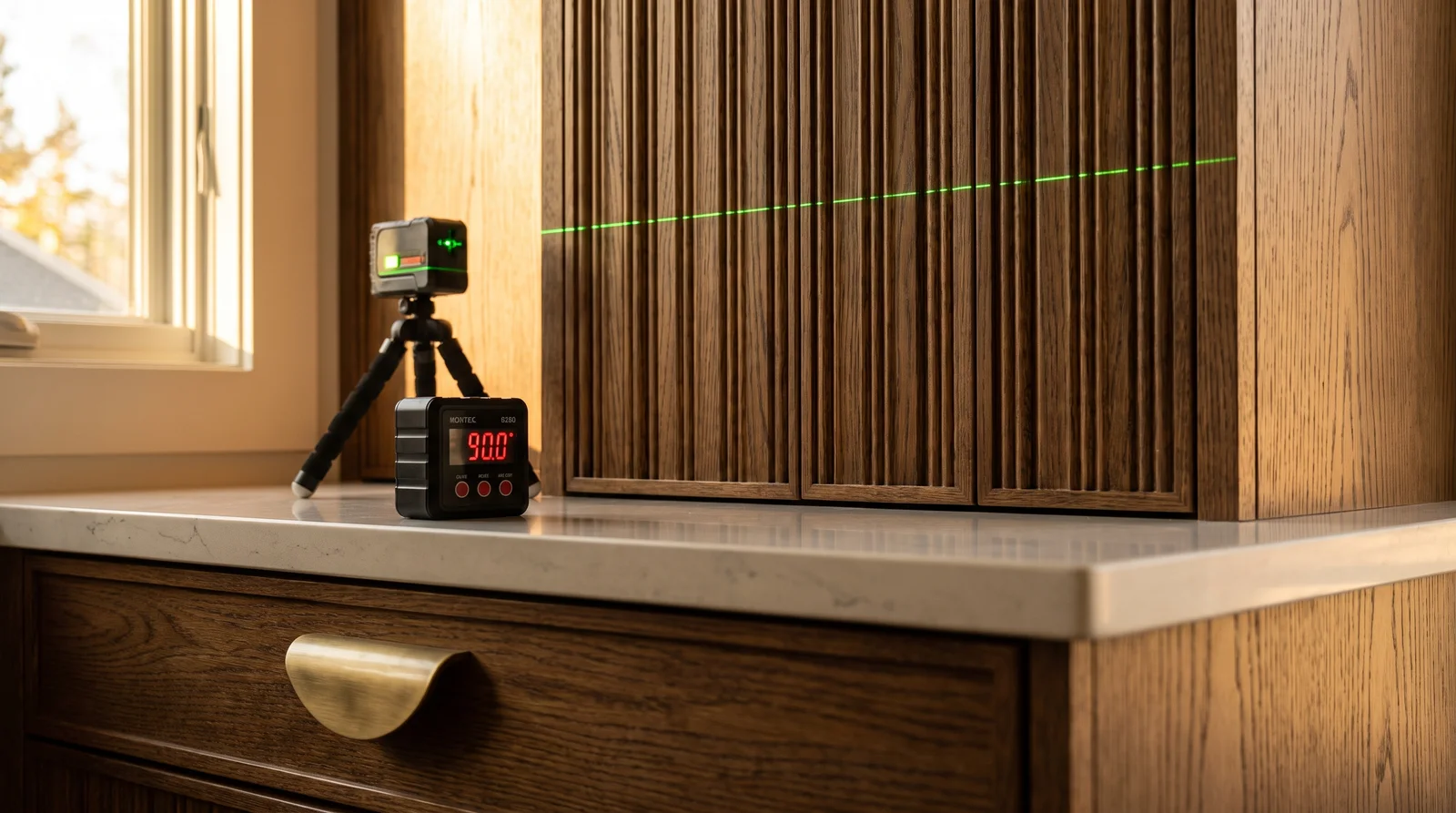
Among the 111 checks on every Élara home, the finish has its own. The approved sample chip travels with the batch and is matched under the same light before the batch leaves the factory. Film thickness is read with a gauge. The sample panel takes a cross-hatch adhesion test, a hot cup and a turmeric smear. On site, every shutter is inspected for runs, dust and edge coverage before it is hung, and the gaps between them are measured, because a perfectly finished door hung unevenly still looks wrong.
The laser checks the hang; the gauge, the sample chip and the turmeric test checked the finish a week earlier.
Repairing it, ten years on
This is the argument for PU that rarely gets made. A chipped laminate door is a replaced door, and the new one will never quite match the old. A chipped matt PU door is filled, sanded and spot-sprayed, and in the same colour code it disappears. A whole kitchen in matt PU can be resprayed in a new colour in a week, without touching a carcass, which is a renovation that costs a fraction of a new kitchen. Gloss is the exception: a repair on gloss shows, so the panel comes off and goes back to the booth. If you want a kitchen you can change your mind about in year eight, matt PU is the finish that lets you.
Six questions before you pay for PU
- Which board is under it? The answer should be HDHMR, not ply and not MDF.
- Is it two-part PU, or duco, or a membrane? Ask them to say the words.
- How many coats of sealer, how many of colour, and is there a clear top coat?
- Is it sprayed in a booth at a factory, and how long does it cure before it is hung?
- For a white or a pale colour: is the top coat non-yellowing?
- Can I see a sample panel, and will the same chip be matched at delivery?
If your kitchen is at the stage where the finish is still a decision, tell us the colour you have in mind and how the family cooks. The first design is complimentary, and the material board that arrives with it carries a real PU chip in that colour, so you can drop a hot cup on it yourself before anything is ordered.
Questions we get asked
- How long does a PU finish last on kitchen cabinets?
- Sprayed properly in a factory, on HDHMR with two sealer coats, two or three colour coats, a clear top coat and a week's cure, a PU finish lasts well beyond ten years of daily cooking and can be spot-repaired in matt. Sprayed thin on plywood on site, it chips at the edges within two or three years.
- Is PU better than laminate for a kitchen?
- PU gives a seamless finish in any colour, allows framed and profiled shutters, and can be repaired or resprayed; laminate is cheaper and harder-wearing but shows edge bands and joints and cannot be repaired. Use PU where you look at the door every day and want colour or a profile; use laminate in the utility, inside wardrobes and where the budget is tight.
- Does PU finish turn yellow?
- All polyurethanes yellow slightly over years in sunlight and heat, and it shows on a pure white. Specify a non-yellowing aliphatic top coat for whites, or choose an off-white such as chalk or warm white, which hides the drift completely.
- What is the difference between duco and PU finish?
- Duco is a nitrocellulose lacquer: cheaper, softer, yellows within a couple of years and marks under heat. PU is a two-part polyurethane that cross-links as it cures, giving a harder, more water- and heat-resistant film. 'PU-duco' on a quote usually means duco with a PU top coat or nothing specific; ask for the exact system.
- How much does a PU finish cost per square foot in Bangalore?
- As installed kitchen cabinetry, matt or satin PU lands around ₹2,600 to ₹3,200 per square foot of cabinetry face, and high gloss ₹2,800 to ₹3,400, against ₹1,700 to ₹2,100 for laminate. Indicative bands; the board, coats and cure time inside that number matter more than the number itself.
Photographs on the Journal are the studio's own visualisations of rooms as designed, captioned as such. Figures are indicative Bengaluru bands, dated in each post, never a quotation.